The Default Mode Network and Large Language Models Share More Than You Think
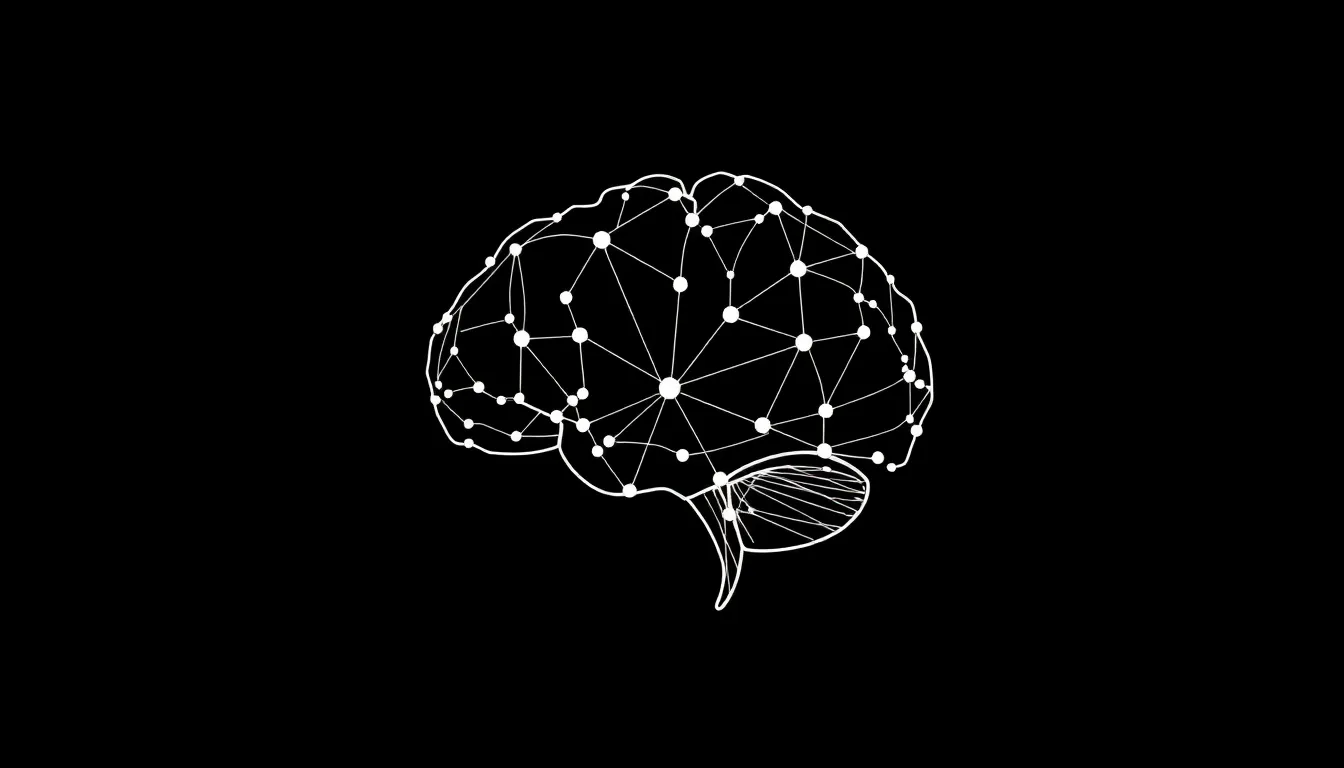
The brain’s default mode network activates when you’re not focused on any specific task. It’s the brain talking to itself. Language models do something strikingly similar — and the comparison reveals deep truths about both systems.
What the Default Mode Network Does
The DMN was discovered by accident. Neuroscientist Marcus Raichle noticed that certain brain regions became more active when subjects weren’t doing anything — just sitting in the scanner, minds wandering. This was unexpected. The assumption had been that an idle brain would be a quiet brain.
Instead, the DMN hums with activity during rest. It generates narratives, simulates social scenarios, replays memories, projects into the future, and constructs the continuous sense of self that ties your experience together. It’s the brain’s generative engine, running in the background, producing a constant stream of internally-generated content.
This content isn’t random. It’s structured by the brain’s learned models of itself and the world. The DMN draws on everything you’ve experienced to generate plausible scenarios, stories, and predictions. Sound familiar?
LLMs as Default Mode Systems
A language model, in its most basic operation, does what the DMN does: it generates plausible content based on learned patterns, without direct sensory input constraining the output. The training data is the model’s “experience.” The generation process is the model’s “mind wandering.”
When you give an LLM a prompt, you’re essentially interrupting its default mode with a task. The model shifts from unconstrained generation to task-focused generation — just as the brain’s DMN deactivates when you start concentrating on a specific task, and the task-positive network takes over.
The parallel extends further. The DMN is implicated in creativity, empathy, and self-referential thought. These are exactly the capabilities that make LLMs most impressive and most problematic. The creative leaps come from the same generative engine that produces hallucinations. The apparent empathy comes from the same narrative construction that sometimes produces manipulation. The self-referential statements come from the same pattern that generates the illusion of understanding.
Task-Positive vs Default Mode in Neural Systems
In the brain, the task-positive network and the DMN are anticorrelated — when one is active, the other is suppressed. But this anticorrelation isn’t absolute. The most creative insights happen when both networks are partially active simultaneously — when directed thinking and free association collaborate.
Current LLM architectures don’t have this dual-network structure. Everything runs through the same forward pass. There’s no separation between “task-focused processing” and “generative wandering.” This means the model can’t modulate between focused accuracy and creative generation — it’s always doing both at once, with no mechanism to adjust the balance.
An architecture that separated these functions — a task-positive pathway for accuracy-critical processing and a generative pathway for creative content — could modulate between them based on context. For factual questions, suppress the generative pathway. For creative tasks, let it run. For complex questions that need both accuracy and insight, let both pathways contribute with appropriate weighting.
Self-Referential Processing and Model Behavior
The DMN is central to self-referential processing — the brain’s construction of a continuous self-narrative. When an LLM says “I think” or “As an AI, I…,” it’s engaging in something structurally similar: generating self-referential content based on learned patterns about what “self-reference” looks like.
Neuroscience research shows that self-referential processing is subject to consistent biases. The brain’s self-model tends toward agency inflation, self-protective narratives, and coherence-seeking even when it’s factually unsupported. These same biases appear in language models. The model generates statements about its own capabilities, limitations, and processes that reflect its training data rather than its actual architecture.
The key insight: the model’s self-referential statements are structured outputs, not evidence of inner experience. But they’re patterns that affect the model’s behavior and user perception regardless of the underlying mechanism. Training models to have accurate self-models — models that match their actual capabilities and constraints — is a concrete alignment objective that mirrors the neuroscience of self-awareness.
Implications for Architecture and Training
Understanding the DMN-LLM parallel suggests several architectural and training innovations. Dual-pathway processing with modulatable balance between generative and task-focused modes. Metacognitive monitoring that can detect when the generative pathway is producing ungrounded content. Self-model components that are accurate rather than performative.
Training protocols can be designed to optimize this separation of concerns. Models can be trained on datasets that clearly distinguish between tasks requiring high task-positive engagement (factual retrieval, mathematical reasoning) and tasks where default-mode thinking is appropriate (creative writing, hypothesis generation). This mirrors how human cognition recruits different networks for different demands.
Curriculum learning approaches can also benefit from this framework. Early training could emphasize task-positive skills, establishing accurate task-focused capabilities as a foundation. Later training can then calibrate the balance between focused and generative processing, teaching the model when each mode is most appropriate.
The Broader Neuroscience-AI Connection
The DMN comparison is just one example of how neuroscience can inform AI architecture and alignment. The brain’s default mode network is the closest natural analog to what LLMs do. Understanding its structure — and understanding how different cognitive states modulate between task-positive and default-mode processing — is one of the most promising paths toward building models that are both capable and aligned.
At Laeka Research, we’re developing these ideas into concrete architectural proposals grounded in neuroscience. The comparison between neural and artificial generative systems provides a principled foundation for designing better, more interpretable alignment approaches.