If AI Is So Smart, Why Does It Fail at Simple Things?
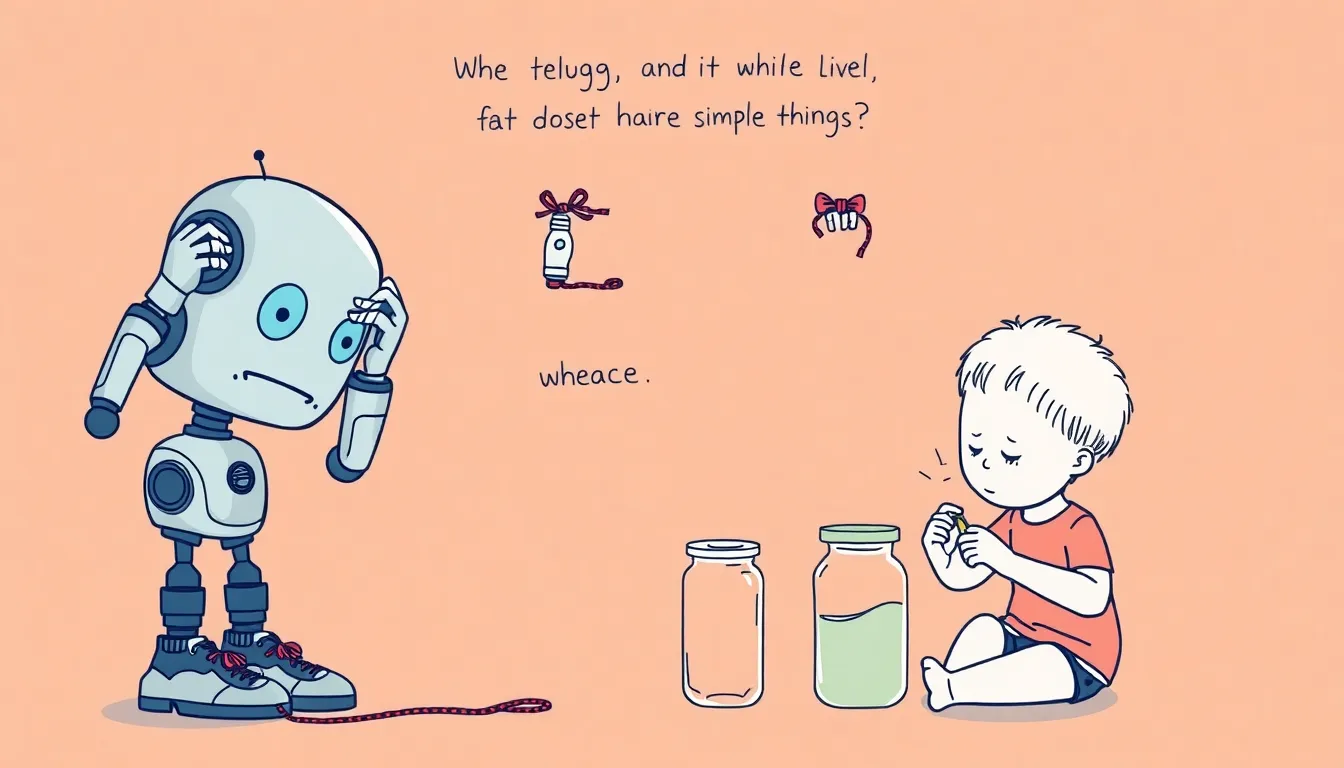
AI can write a 2000-word essay in 30 seconds, but it can’t count the number of letters in “strawberry”. It can solve complex equations, but it fails at “what weighs more, a kilogram of feathers or a kilogram of bricks?” How is that possible?
Moravec’s Paradox
In 1988, researcher Hans Moravec observed something fascinating: what’s easy for a human is difficult for a machine, and vice versa. Walking, seeing, and understanding language are trivial for humans — we do them effortlessly from childhood. But for machines, these are incredibly hard problems.
Meanwhile, calculating a million-digit number? Trivial for a computer. Recognizing a pattern in a massive dataset? Easy. But a child can do both of these too — they just use intelligence, not raw computation.
AI inverts this. It’s brilliant at tasks that seem complex to humans but are actually just pattern-matching at scale. It’s terrible at tasks that seem simple but actually require genuine understanding.
Why Counting Letters is Hard
When you ask an AI to count the letters in “strawberry”, it doesn’t actually count. It generates text token by token based on patterns it learned. The pattern it learned is mostly about language meaning, not about letter-by-letter counting.
It’s like asking a language translator to give you a precise technical measurement. The translator is brilliant at their job, but that job isn’t measurement.
Why the Trick Question is Tricky
“What’s heavier, a kilogram of feathers or a kilogram of bricks?” is a trick question — the answer is they weigh the same. But to get this right, the AI has to understand a very specific gotcha: people expect bricks to be heavier because bricks are individually heavier, and the AI has to notice that the weight specification (kilogram) overrides the intuitive expectation.
That’s a form of reasoning that requires the AI to catch a subtle logical trap. It’s not impossible for AI — but it’s not what AI was optimized to do.
The Distinction Matters
For legal work, this is important to understand. AI is brilliant at:
- Finding patterns in case law
- Extracting key terms from contracts
- Summarizing long documents
- Identifying precedents that might apply
AI is weak at:
- Understanding genuine ambiguity (does this clause mean X or Y?)
- Catching logical contradictions
- Reasoning about edge cases it hasn’t seen before
- Understanding what a contract truly means to the parties involved
This is why AI is such a good research assistant but a terrible decision-maker. Use it to gather the information, not to decide what it means.
The Future
Newer AI models (GPT-4, Claude 3) are getting better at reasoning tasks that require actual understanding rather than pattern-matching. We might eventually have AI that’s equally brilliant at both — but we’re not there yet.
Understanding these limitations isn’t a reason to dismiss AI. It’s a reason to use it correctly: as a tool for specific tasks, not as a replacement for judgment.