How AI Learns: Like a Child, But 1000x Faster
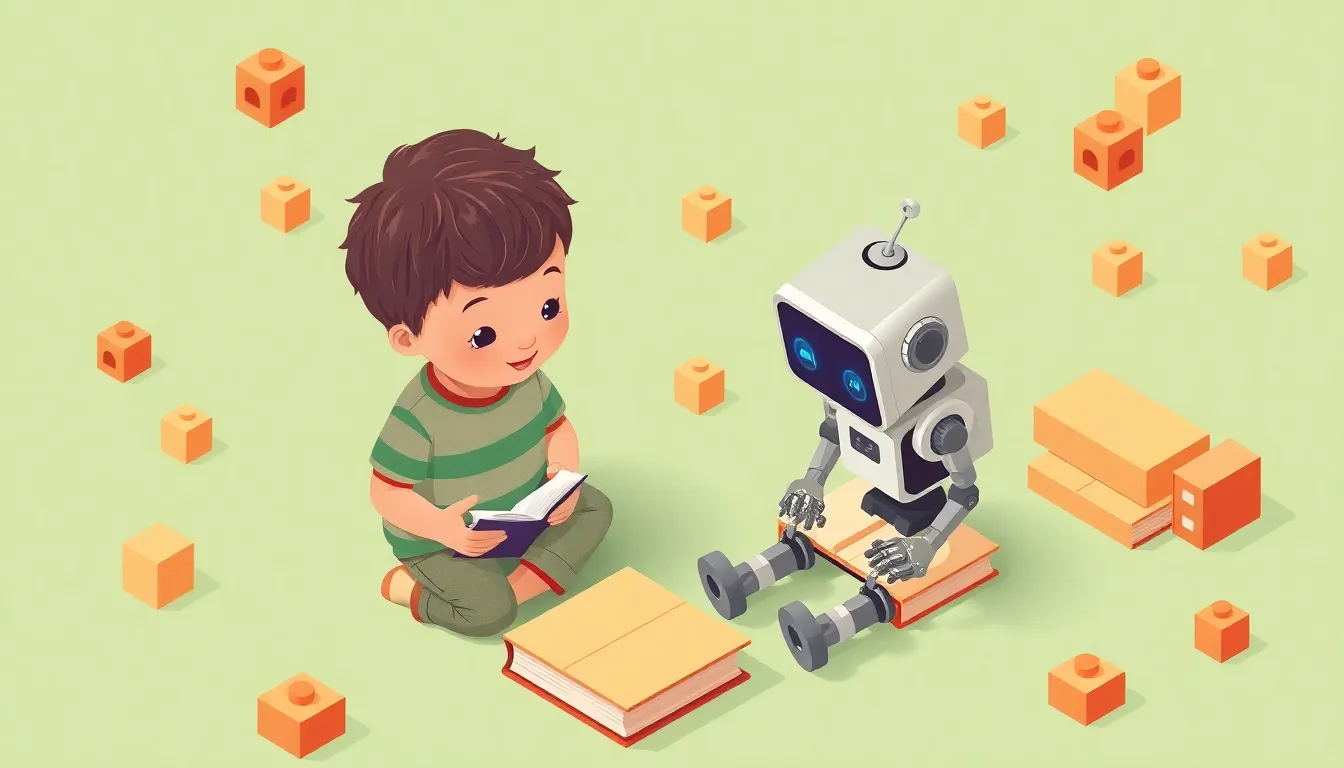
When a baby learns to talk, nobody hands them a dictionary. They listen to the people around them, recognize patterns, and start reproducing sounds. “Ma-ma.” “Da-da.” “No!” (That one, they learn fast.)
AI learns the same way. Except instead of listening to its family for 3 years, it analyzes billions of texts in a few weeks. And instead of saying “ma-ma,” it says “The mitochondria is the powerhouse of the cell.”
Training: AI’s daycare
When we “train” an AI, we show it tons of data. For a language model like ChatGPT, that data is text: books, websites, articles, forums. Billions and billions of words.
The model looks at these texts and learns to predict: which word comes after which word? If you see “The cat sat on the ___,” the word “mat” is more likely than “volcano.” The model learns these probabilities by seeing millions of examples.
It’s not more complicated than that. AI is a glorified word predictor. But when you do this at the scale of hundreds of billions of words, something surprising emerges: the model starts to “understand” grammar, facts, logic, style — without being explicitly taught any of these concepts.
Mistakes make the learning
Like a child, AI learns through trial and error. At the start of training, its predictions are completely random. Gibberish. Then, with each mistake, its parameters get adjusted a tiny bit. After billions of adjustments, the predictions become good.
It’s like learning to shoot a basketball. The first shots go everywhere. But with each throw, your brain adjusts the angle, the force, the wrist a little. After thousands of shots, you’re sinking baskets with your eyes closed.
The difference? AI makes billions of “shots” per day. That’s why it takes weeks instead of years.
The big difference with humans
A child learns language with a few thousand hours of conversation. ChatGPT needed the equivalent of millions of years of reading. AI is fast in compute time, but incredibly inefficient compared to the human brain.
And most importantly, a child learns in context. They know “hot” burns because they touched the stove. AI knows that “hot” and “burn” often appear in the same sentences, but it’s never been hurt.
That difference is why AI can write a poem about pain without ever having suffered. It knows the words of pain. Not the experience.
Why this matters
Understanding how AI learns changes how you use it. You know its answers are based on statistical patterns, not deep understanding. You know it’s good for well-documented topics and bad for obscure ones. You know its “mistakes” aren’t stupidity — they’re the limits of a system that predicts words.
At Laeka Research, we study these learning mechanisms to understand how to make them better and more aligned with how humans actually think. And with Sherpa, we explain all of this simply, for free.